
фікс
фікс
September 1, 2026
read more


“In public space, people are increasingly unwilling to accept a predefined сценарій of presence. They want to be among others, but still maintain control over distance, comfort, and the way they interact. That is why street furniture should not be seen as a secondary element of urban design, but as a tool for shaping social behavior. And that is exactly why most of the solutions we still see in cities no longer reflect real ways of living.”
When we talk about the quality of public space, the conversation usually quickly shifts to materials, greenery, lighting, accessibility, maintenance, budgets, and visual cohesion. All of this is indeed important. But there is a layer that often remains underexplored — how exactly a space allows a person to exist among others.
I describe this through the concept of social individualism.
In my understanding, this is a state of public life where a person does not reject the city, does not escape into isolation, and does not deny the value of shared space. They want to be part of urban (or suburban, or rural) life, but at the same time seek to maintain control over their own boundaries: distance from others, the format of interaction, the duration of stay, the way they use the space, and the level of engagement.
This is a significant shift. Publicness no longer means unconditional willingness to share space under a single scenario. A contemporary user wants not only access to space, but also the right to define how they exist within it.
This is where street furniture becomes fundamentally important
As a society, we have treated it for too long as a final layer of a project. First comes architecture, then flows, then surfaces, then planting — and only at the end: benches, bins, bike racks, bollards, small elements.
Because of this, furniture is often perceived either as a portfolio item, part of a composition, or a procurement unit with a strict technical specification. In such logic, the priority is price, sometimes durability, quantity, coatings, anti-vandal features, occasionally style (though even that is often compromised by cost).
But street furniture is never just equipment.
It shapes how people co-exist in space. It defines whether a person can pause briefly without occupying a “full seat.” Whether they can sit without physical contact or invading someone’s personal space. Whether they can be alone without leaving the public realm. Whether the space supports a short pause, a longer wait, conversation, observation, rest, accompanying a child, leaning for support, cycling, or different modes of presence — more open or more private.
Without this choice, space remains public only formally
This is most clearly seen in something as simple as a bench.
A long, continuous bench without divisions is not a neutral solution. It suggests a specific type of social interaction. It assumes that people are comfortable sharing space without conditions, that proximity does not create tension, that distance is not an essential part of comfort, and that all users experience shared seating in the same way.
But that is no longer the case.
One person wants to sit for two minutes while replying to a message. Another is waiting for a child after a class. A third needs to rest while passing by. Someone is looking for a place to talk. Someone else wants to be alone — but not isolated. Someone arrived by bicycle. Someone moves more slowly and needs stable support. Someone is mentally exhausted and avoids unnecessary contact. Someone is willing to be around others, but not in physical proximity.
And in the context of our current security situation and collective mental state, this list is even broader — and often invisible.
All these scenarios coexist in the same city. Yet design decisions often assume a single average user with a single basic need: to sit.
This is one of the core problems.
We design not for real people, but for an abstract user — one without behavioral nuances, emotional states, social fatigue, or the need for personal boundaries. This user is convenient for drawings and budgets, but has little in common with reality.
What makes good street furniture today
It should not be evaluated only by physical characteristics, but by whether it acknowledges the complexity of contemporary public life.
Does it allow a choice between proximity and separation?
Does it support different types of use?
Does it reduce everyday social friction?
Does it recognize that comfort is not only ergonomic, but also psychological?
Does it allow people to be in the city without constantly adapting to others?
In practice, this means very concrete things: modularity instead of uniformity, multiple seating types within one space, combinations of sitting, leaning, pausing, waiting. Orientation that does not force frontal exposure to pedestrian flows. Semi-privacy created through layout, greenery, rhythm, armrests, backrests, and spatial breaks.
These are not details. This is the essence of usability.
Why is this still often ignored?
Because many clients and some designers still think in terms of objects, not behavior. If a bench is durable, visually appropriate, and within budget, the problem is considered solved. How people will actually use it is often seen as secondary — or too subjective to define in a brief.
Another reason is that behavioral scenarios are harder to describe than material thickness or coatings. They are harder to procure, harder to defend in meetings focused on cost and quantity.
(At the same time, it’s important to acknowledge that many designers we work with at Fix Street Furniture already deeply understand and work with this layer — and it is truly inspiring.)
But complexity does not mean less importance.
Quite the opposite: what is difficult to measure often determines whether a space will actually be used. We all know places that have everything on paper, but feel empty. And others where people stay, return, observe, meet — even with minimal elements. The difference often lies not in materials, but in a deeper understanding of human behavior.
A shift in how we understand public space
The idea of personal boundaries in public space is still sometimes perceived as suspicious — as if avoiding close contact is a sign of social coldness. As if good public space must eliminate all distance.
But quality public space does not begin with enforced proximity. It begins with respect for different ways of being among others.
That is why social individualism should not be seen as a problem to fix through design. It is a real condition of contemporary life. People have changed. Their pace has changed. Their sensitivity to boundaries has changed. Their fatigue from noise and constant interaction has changed.
If design does not reflect this, it operates with an outdated model of the user.
In conclusion
Street furniture is a precise indicator of whether a project respects real people — not diagrams, not averages, not renderings, but living individuals with complex and sometimes contradictory ways of being in the city.
The city of the future will not be better simply because it has more benches. It will be better when it offers more ways to be oneself — to be among others without losing that sense of self.
And perhaps this is one of the most important задач of contemporary design: not just to create shared spaces, but to create spaces where shared life does not eliminate personal autonomy.
Because sometimes the level of urban culture can be measured very simply — by whether a person is given the freedom to decide how to sit, wait, pause, be present, and still remain themselves.
This is about freedom — something we all deeply value.
We are Fix - Street Furniture, a company dedicated to designing and creating high-quality street furniture that combines functionality and aesthetic appeal.
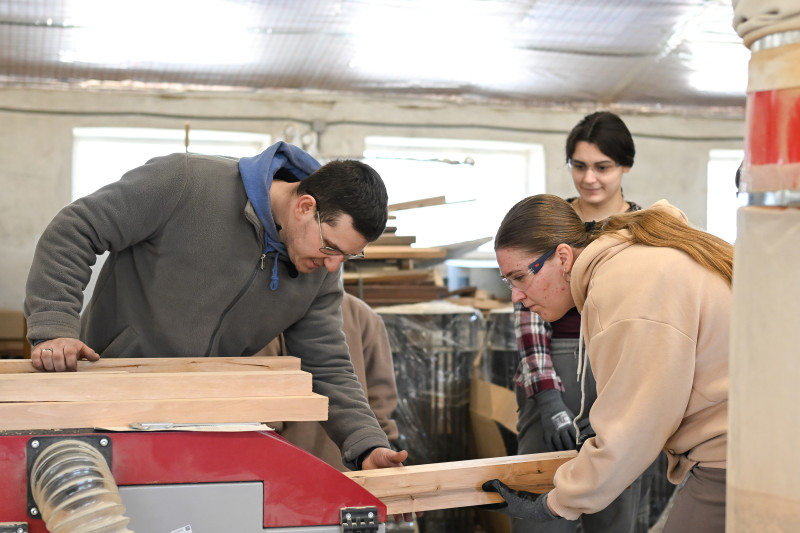
FIX Street Furniture and the Lviv Professional College of Applied Arts and Design are strengthening their cooperation to prepare skilled professionals for the modern manufacturing sector.