фікс
фікс
September 1, 2026
read more


In the design of public spaces and residential developments, street furniture is often treated as a secondary element. That is why, at the budgeting stage, choosing cheaper benches may seem logical and justified. However, real-life operation shows the opposite: a low initial price almost always results in a higher total cost over the project’s lifecycle.
A cheap bench looks attractive only on paper. In real urban conditions, it begins to lose its performance after the first year of use. Thin metal, simplified joints, and low-quality protective coatings cannot withstand climate exposure, intensive use, and seasonal temperature changes.
The result is corrosion, loosened structures, damaged wood, and loss of visual quality. After one or two seasons, such elements require repair or complete replacement, automatically generating additional costs for dismantling, installation, and logistics.
Any intervention in an already completed environment is not only a financial issue. It also involves organizational resources, team time, user discomfort, and the risk of damaging adjacent landscape elements. What initially appears as savings gradually turns into ongoing operational hassle.
For developers or municipal clients, this means unpredictable expenses during operation and an increase in the overall cost of ownership.
Street furniture is constantly in the users’ field of view. Benches are used, waited on, photographed, and become part of the visual identity of a place. When a bench looks worn, squeaks, or feels unstable, it devalues not only the element itself but the architectural concept as a whole.
For residential and commercial projects, this directly affects perceived quality, trust in the developer, and the long-term value of the asset.
Budget street furniture is rarely designed with partial repair in mind. In most cases, the failure of a single component means replacing the entire bench. In the long run, this leads to repeated procurements and significantly increases cumulative costs.
Well-designed solutions, by contrast, allow for the replacement of individual components without dismantling the entire structure, substantially reducing maintenance expenses.
For architects and developers, the key question is not the unit price, but the lifecycle cost. When expenses are evaluated over five or ten years, it becomes clear that cheap solutions almost always turn out to be the most expensive.
High-quality street furniture ensures predictable operation, a stable appearance, and minimal intervention over many years.
At FIX Union, we work with a long-term value mindset. We design street furniture with real loads, climate conditions, and intensive use in mind. We also incorporate the possibility of maintenance and replacement of individual elements rather than entire structures.
In practice, the client invests not only in materials, but in predictable costs, stable environmental quality, and reduced risks throughout the entire service life.
That is why, in the long term, a high-quality bench costs less than any short-term “saving” at the start of a project.
Explore our completed projects — and let’s work together.
We are Fix - Street Furniture, a company dedicated to designing and creating high-quality street furniture that combines functionality and aesthetic appeal.
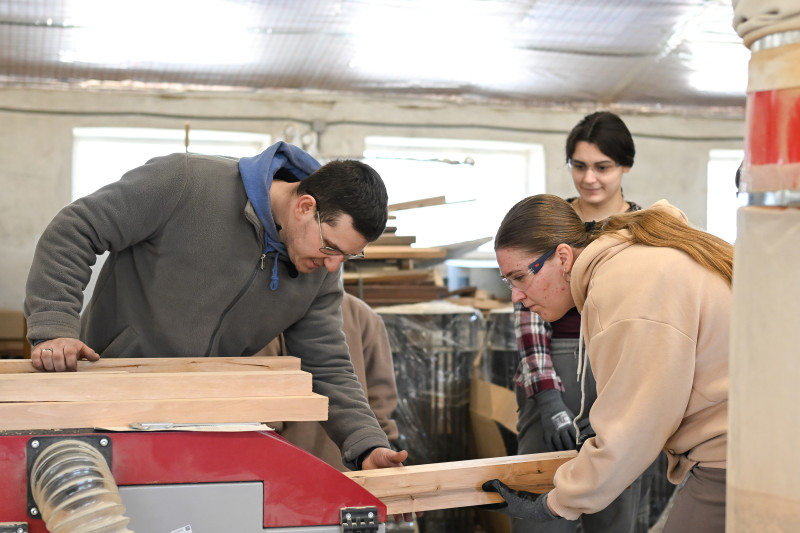
FIX Street Furniture and the Lviv Professional College of Applied Arts and Design are strengthening their cooperation to prepare skilled professionals for the modern manufacturing sector.